Eagle’s Brief

The Law on Malicious Arrest and Prosecution in light of Ndlovu v Mazibuko and Another (HC 1424/21) [2026] ZWBHC 96 (30 April 2026)

The plaintiff sued the defendants for damages arising from alleged malicious arrest, prosecution, and imprisonment. He claimed they knowingly made a false theft report to remove him from Mjingwe Conservancy, causing his conviction and significant financial and personal losses.  The defendants denied acting maliciously, maintaining that the plaintiff had only borrowed the motor vehicle, that […]

The Law on Malicious Arrest and Prosecution in light of Ndlovu v Mazibuko and Another (HC 1424/21) [2026] ZWBHC 96 (30 April 2026) Read More »

Inheritance of A2 Agricultural Land in Zimbabwe: Reflections on Mutale v Nyikadzino and Others HH 303/26

The decision in Mutale v Nyikadzino and Others (5170 of 2025) 2026 ZWHHC 154 brings into sharp focus the unresolved legal complexities surrounding inheritance of A2 agricultural land allocated under Zimbabwe’s land reform programme. Since the advent of the Fast Track Land Reform Programme, agricultural land has been allocated through offer letters and lease agreements. However, the

Inheritance of A2 Agricultural Land in Zimbabwe: Reflections on Mutale v Nyikadzino and Others HH 303/26 Read More »

Navigating the Boardroom Transition: Statutory Precision and Procedural Integrity Under Zimbabwe’s C.O.B.E Act

The boardroom of a Zimbabwean company is not a space for informal handshakes or arbitrary adjustments. Under the Companies and Other Business Entities Act [Chapter 24:31] (the COBE Act), managing a transition whether introducing new expertise or unseating a non-performing officer demands moving completely away from generic templates toward a procedurally exact, statutory framework.  In corporate governance,

Navigating the Boardroom Transition: Statutory Precision and Procedural Integrity Under Zimbabwe’s C.O.B.E Act Read More »

Equity in the Law of Property

Introduction  In Zimbabwean property law, the principle of accession dictates that any building or development permanently attached to land becomes the property of the landowner (quicquid plantatur solo, solo cedit).   To prevent unfair windfall gains, Roman-Dutch common law utilizes the doctrine of unjust enrichment. While bona fide (good faith) possessors enjoy robust legal protections, Zimbabwean law also extends

Equity in the Law of Property Read More »

Balancing Civil Marriage and Cohabitation Rights in Pension Disputes

Introduction  What happens when the law recognises one relationship as valid on paper, but another as real in practice? And more importantly, which of the two should matter when death forces the distribution of a lifetime of earnings?  The Mutare High Court in Satimburwa v Susan Njokoya & Anor HCMTJ 60-25, was confronted with exactly

Balancing Civil Marriage and Cohabitation Rights in Pension Disputes Read More »

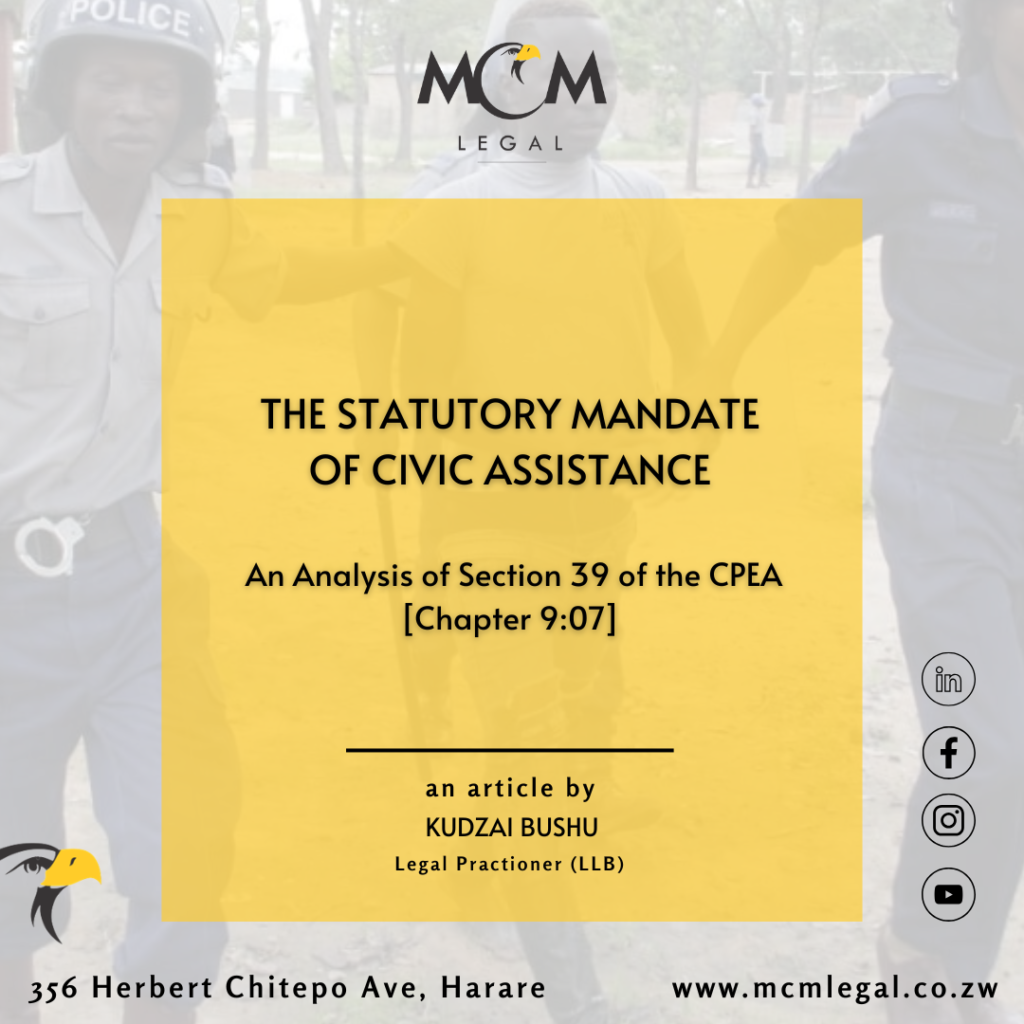
THE STATUTORY MANDATE OF CIVIC ASSISTANCE:
An Analysis of Section 39 of the CPEA [Chapter 9:07]

Introduction In the Zimbabwean legal landscape, the boundary between civilian life and law enforcement is bridged by a little-known but potent statutory obligation: The duty to assist a police officer. While modern policing often emphasizes professional boundaries, Section 39 of the Criminal Procedure and Evidence Act [Chapter 9:07] (CPEA) preserves a traditional “posse comitatus” power,

THE STATUTORY MANDATE OF CIVIC ASSISTANCE:
An Analysis of Section 39 of the CPEA [Chapter 9:07]
Read More »

TESTAMENTARY FREEDOM VS SPOUSAL PROTECTION
a surviving spouse’s legal rights to the matrimonial home

What happens to the matrimonial home when death interrupts a marriage? For many, the answer seems obvious; the surviving spouse remains protected and inherits. Yet, under Zimbabwean law, that expectation can either be firmly upheld or completely undone, depending on one critical factor, whether the deceased left a valid will. This tension between protection and

TESTAMENTARY FREEDOM VS SPOUSAL PROTECTION
a surviving spouse’s legal rights to the matrimonial home
Read More »

CHIMBAZO PRACTICES IN LIGHT OF THE MONEYLENDING AND RATES OF INTEREST ACT [CHAPTER 14:14]:
A Legal Perspective

Introduction The growth of informal lending practices, commonly referred to as chimbazo, has raised important legal concerns within the framework of the Moneylending and Rates of Interest Act [Chapter 14:14]. Although such lending provides quick access to funds, it often operates outside the protections and requirements of the law, exposing borrowers to potential exploitation. 1.Legal

CHIMBAZO PRACTICES IN LIGHT OF THE MONEYLENDING AND RATES OF INTEREST ACT [CHAPTER 14:14]:
A Legal Perspective
Read More »

PUBLIC PARKING LAND, REZONING AND THE RULE OF LAW IN ZIMBABWE:
A Doctrinal Analysis of the Mabelreign Controversy

1.Introduction Urban land governance in Zimbabwe is increasingly defined by a structural tension between formally regulated planning systems and informal or semi-formal occupation of municipal land. This tension is particularly acute in rapidly urbanising areas where economic pressure, informal commerce and local governance discretion intersect with rigid statutory planning frameworks. The legal question that repeatedly

PUBLIC PARKING LAND, REZONING AND THE RULE OF LAW IN ZIMBABWE:
A Doctrinal Analysis of the Mabelreign Controversy
Read More »

The Juridical Economic Paradox of Informality: Labour Law, Workers’ Rights and Social Protection in Zimbabwe’s NDS2 Era

Introduction Informal employment has become the defining structural feature of Zimbabwe’s contemporary economy, shaping labour relations, legal protections and social welfare outcomes. While the de jure (by law, as written) statutory framework  cantered on the Labour Act [Chapter 28:01] as amended by the Labour Amendment Act No. 11 of 2023 and underpinned by the Constitution of Zimbabwe

The Juridical Economic Paradox of Informality: Labour Law, Workers’ Rights and Social Protection in Zimbabwe’s NDS2 Era Read More »

Scroll to Top